
How Knowledge Workers Are Restructuring the Workday in 2025
As meetings multiply and messages never stop, employees are quietly rebuilding their days around focus instead of the clock.

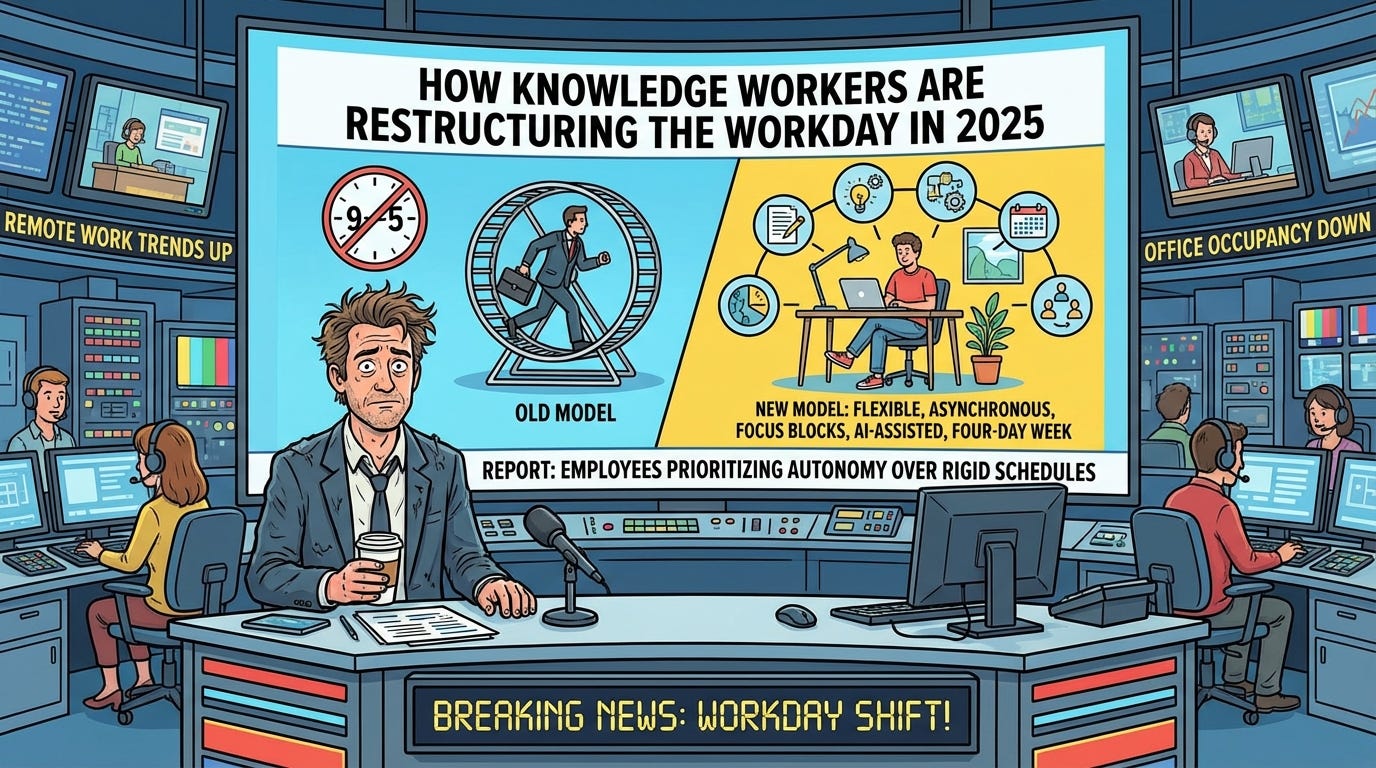
For many knowledge workers, the traditional workday—set hours, linear tasks, clear starts and stops—no longer matches how work actually gets done.
Interviews, surveys, and workplace studies conducted in early 2025 show a growing gap between official schedules and real working patterns. Faced with rising workloads, constant communication, and fragmented attention, employees are informally redesigning their days to make work possible at all.
What’s emerging isn’t a shorter workday or a more relaxed one—but a reconfigured one.
The new workday pattern
Across industries, several common adjustments are showing up again and again:
Delaying deep work. Many employees push focused tasks to late mornings, early evenings, or after-hours windows when messages slow down.
Treating meetings as the “day job.” Core working hours are increasingly dominated by calls, check-ins, and coordination, leaving little space for execution.
Shifting real work outside standard hours. Writing, analysis, and problem-solving often happen before the workday officially begins or after it ends.
These adaptations help individuals protect focus, but they also blur boundaries between work and personal time. In effect, the workday hasn’t disappeared—it has fractured.
The pattern exposes a deeper issue: much of the modern workday is optimized for coordination, not creation.
The cost of constant coordination
Researchers and workplace experts point to coordination overload as a central driver of this shift. Messages, meetings, status updates, and approvals now consume more time than actual execution in many knowledge-based roles.
As a result, workers are building informal systems to survive the day—blocking calendars, ignoring messages temporarily, multitasking across calls, or working asynchronously without explicit approval.
These workarounds often succeed at an individual level but create organizational blind spots. Managers may see availability without progress, while employees experience progress without visible recognition.
Why this matters for employers
Companies that treat these changes as personal time-management quirks risk missing a structural signal.
Organizations that fail to adapt face higher risks of:
Declining engagement as work feels fragmented and reactive
Reduced creativity due to constant interruption
Increased attrition among experienced employees who burn out quietly
By contrast, employers that acknowledge how work is actually happening—and redesign roles, schedules, and expectations accordingly—may gain an edge in retention, output quality, and long-term performance.
The way knowledge workers structure their days in 2025 isn’t a rebellion. It’s a response. And it’s already reshaping the future of work—whether companies notice or not.
Related coverage:
→ Why Burnout Is Rising Among U.S. Workers in 2025
→ Companies Are Rethinking Hustle Culture as Productivity Stalls